
Delivered, according to the email
The email arrived at 8.16 on Saturday morning. “Your order is complete.” Alex read it while standing sideways between a cardboard box and the front door. Behind him, six packages stretched down the hallway of the London flat he shared with Mara. One was approximately the length of their weekend.
The wardrobe had looked calm on the website. It stood in a bedroom containing a bed, a plant and no visible evidence that anybody owned socks. Their bedroom contained a bed, two suitcases, a drying rack and an old chest of drawers with one handle missing. The plant was dead, but still occupying valuable floor space.
Mara had measured the alcove. Alex had checked the delivery date. Each felt they had performed the important part of the operation. Neither had thought very hard about where the long panels would go while the wardrobe was becoming a wardrobe.
They opened the smallest box first, a decision based entirely on optimism. Inside were enough fittings to make the borrowed screwdriver look underqualified. By nine, the bed was covered with labelled bags and the instructions had been flattened beneath a coffee cup. By ten, they were discussing whether “clear the room” had meant the same thing to both of them.
It had not.
The price of a free Sunday
They were not especially bad at practical work. Alex had put up shelves before. Mara was patient with instructions and better at finding things that rolled under furniture. The difficulty was that every step seemed to require the space currently occupied by another step.
To move the bed, they needed somewhere for the mattress. To empty the chest of drawers, they needed somewhere for the clothes. The hallway had already been claimed by the packaging, and the living room was where Mara was supposed to join a work call on Monday. Their home had become a sliding puzzle with no empty square.
At lunchtime Alex said they could finish tomorrow. Mara asked what, exactly, tomorrow had done to deserve that. They laughed, which helped. Then she looked at the product page again and sent an enquiry for furniture assembly, including the wardrobe model and photographs of the room.
The reply did not begin with “easy job”. It asked whether all the packages had arrived, whether the old furniture was staying and where the finished wardrobe should stand. There was also a question about the wall and any permission needed for the fixing the product required. It was the first conversation that treated the room, rather than the boxes, as the job.
They agreed an appointment after the remaining arrangements were settled. Sunday was not magically restored. They spent part of it making working space and putting the fittings safely together. But they stopped opening new boxes in the hope that progress might emerge from one.
The person who did not open the box
When the assembler arrived, the first thing he did was walk into the bedroom. The boxes remained unopened. He checked the intended position, the product instructions and the room available to work. Alex watched this with the slight discomfort of someone remembering how confidently he had begun.
There was a conversation about the wardrobe door nearest the bed. It could open, but only just, and the chest of drawers narrowed the route through the room. Mara had imagined the finished furniture individually. The assembler was looking at what happened when a person tried to use all of it.
They changed the position of the chest before the heavy work began. It was an unglamorous decision involving a tape measure and a laundry basket. It also meant that the wardrobe would not spend the next several years making the room a little annoying every morning.
The work itself was less theatrical than their Saturday. Parts were checked, the instructions stayed visible, and each stage had somewhere to happen. When a question about fixing arose, it was resolved before the furniture was treated as ready to use. Nobody improvised a promise about an unfamiliar wall.
By the time the doors were being checked, Alex had stopped offering helpful commentary. Mara was sitting in the living room, reading something that was not an assembly manual. The room was still theirs, with the same bed and the same unfortunate plant. It was beginning to work differently.
What finished looks like
The wardrobe standing upright was the most obvious milestone. It was not the last one. There were doors to check, an agreed fixing to complete, a working area to clear and a final look at how the piece sat in the room. Packaging disposal had been discussed separately; the cardboard did not acquire a destination simply because everyone was tired of seeing it.
Alex had imagined paying somebody for the part involving tools. What he had actually wanted was an end to the sequence of unresolved decisions. The assembler knew what had to be settled before beginning, what could change along the way and what had to be true before leaving.
That knowledge was difficult to see on a product page. It was also absent from the delivery confirmation. A retailer could correctly say the order was complete while the household was still several awkward decisions away from being able to put away a shirt.
On Monday morning, Mara opened the wardrobe without moving anything else first. Alex found his jacket without lifting it off a dining chair. They were small events, not the sort anyone photographs for a dramatic before-and-after. Yet they were the reason for buying the furniture in the first place.
The email had been early. Now the room was finished.
Editorial note
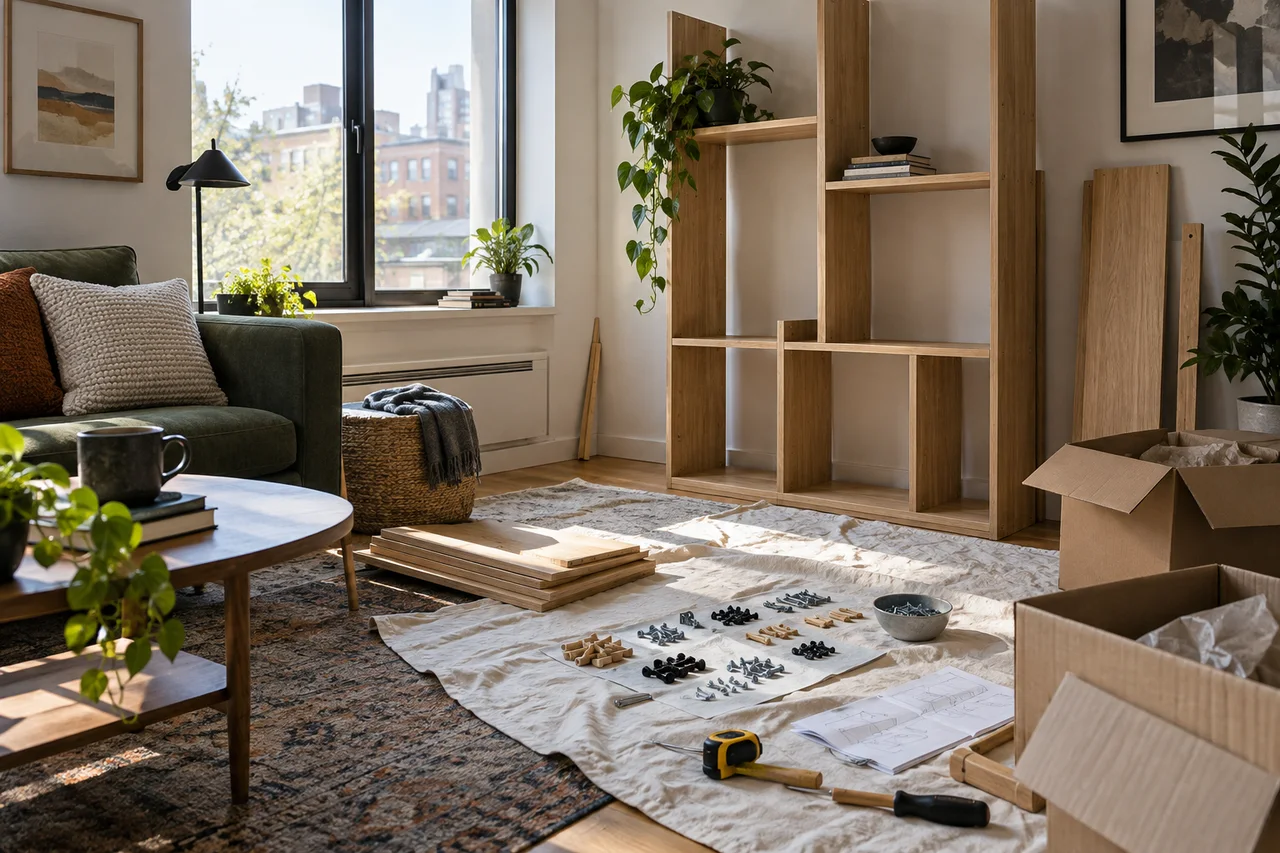
- About this story An illustrative fictional story: the characters, dialogue, timings and events are invented to explore an everyday property situation. This is not a documented Perfect Living customer case, testimonial or claim of results. The photograph illustrates the subject; it does not show the people or property in the story.